
Ginger Krebs’s


introduction
Ensemble projects I’ve made over the past ten years have addressed power as it is implemented through technologies, and Protected By Invisible Fence extends and updates this investigation for 2026. It is a movement-based performance for eight dancers and eight crowd control stanchions, which are equipped with custom sensing devices that track the human performers and respond to their proximity, touch, and voices with sound and light. Protected by Invisible Fence uses humor to expose myths about technology’s supposed neutrality, and aims to capture the nauseating “undertow” by which technology manipulates users’ behavior. The performance is inspired by a phenomenon that Byung-chul Han calls “smart power,” which he describes as a “technology of power that operates seductively, rather than repressively, to make sure that people subjugate themselves to domination by consuming and communicating - and clicking ‘Like’ all the while” (Psychopolitics: Neoliberalism and New Technologies of Power).
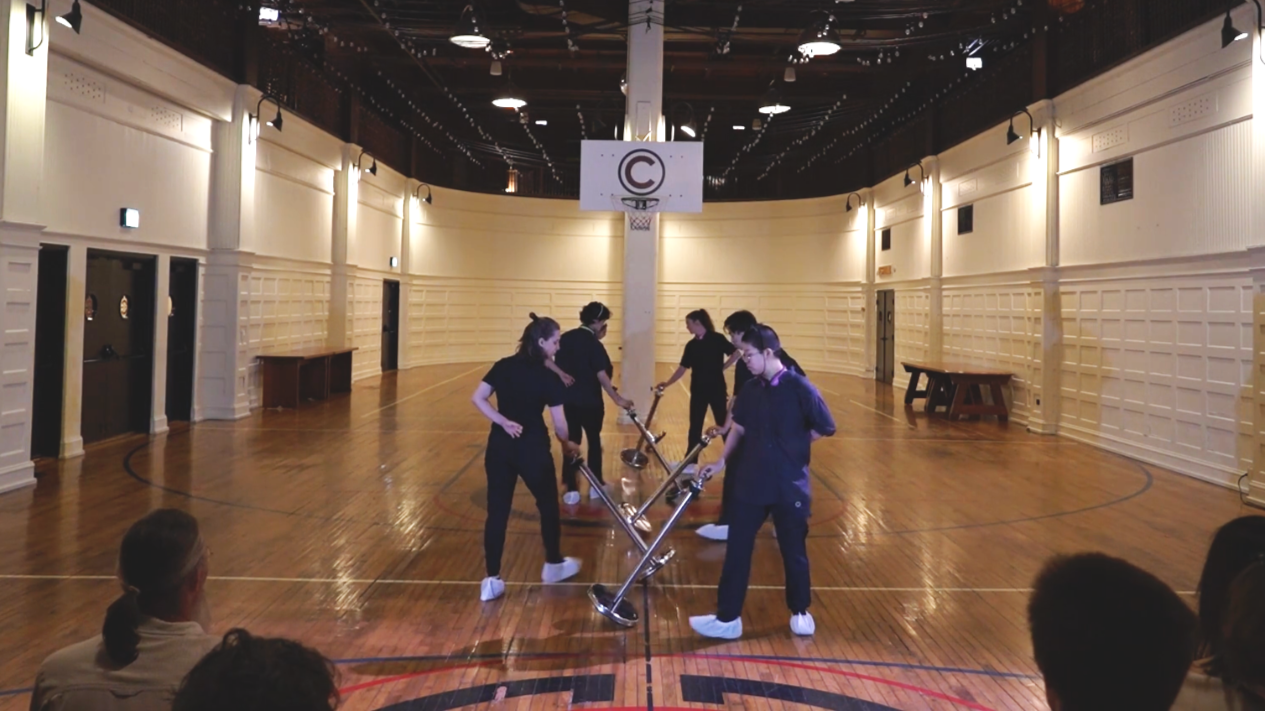
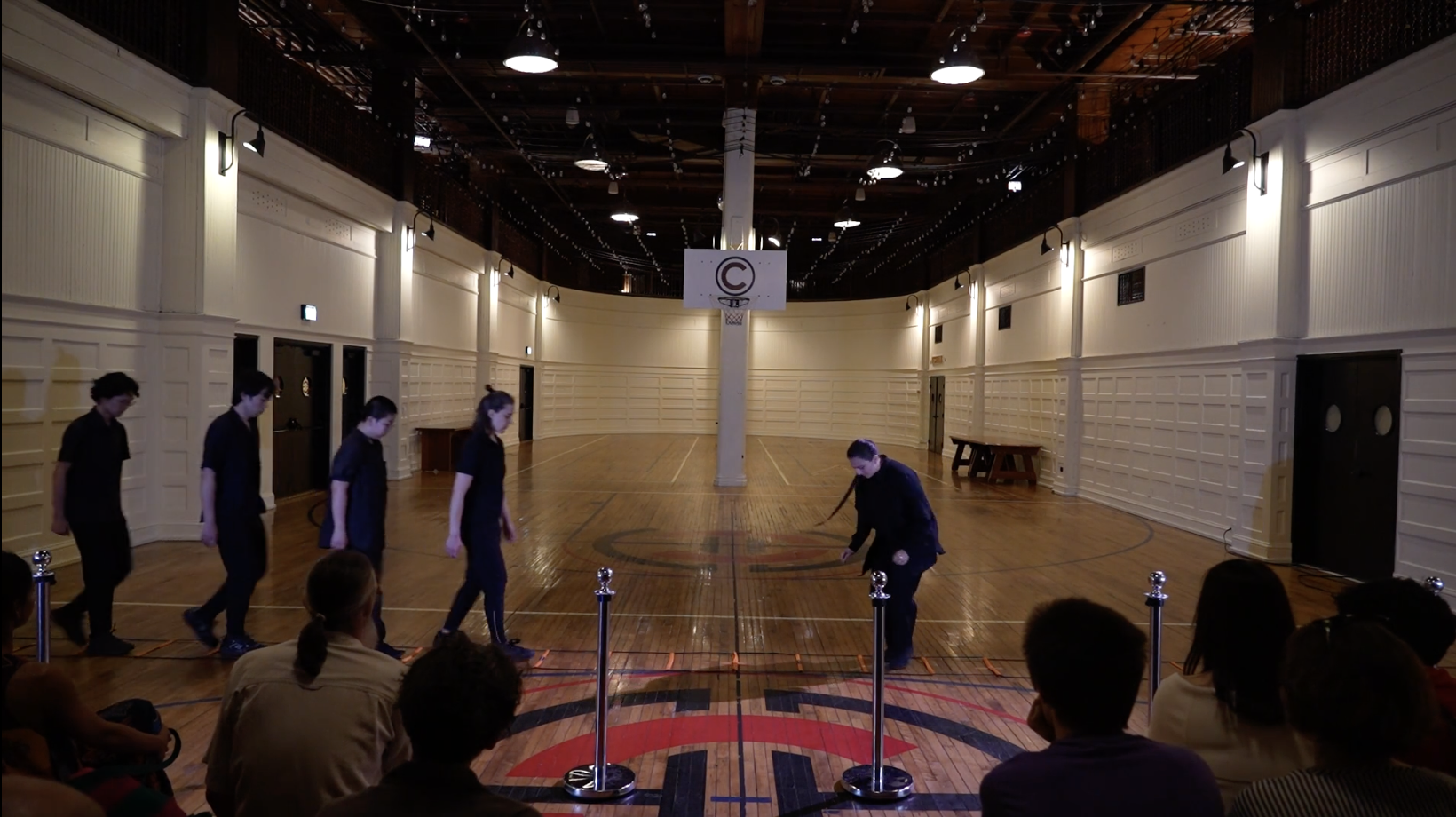
Images from work-in-progress show at the Chicago Athletic Association Hotel.
Protocols made visible
When I started this piece, I wanted to build a responsive system that the performers could influence and be influenced by. I wanted to put technology at the functional center of the work, rather than using it "decoratively". I don't care for the performance to have a technological aesthetic, but I do care that the performance considers deeply the ways that technological protocols impact human bodies, relationships, and privacy. That the tech drives the human behavior is really important because I want to create a parallel world, subject to similar constraints as the "real" world. But in the world of the performance, the technological protocols are exposed, rather than hidden, so it's possible to see them shape how we move and interact.
We have used work-in-progress showings to test if we could make cause-effect relationships between the performer’s actions and technological responses by the stanchions clear and legible to an audience. Surveillance technologies are parasitic, in the sense that they don't generate original content, but watch and record the actions of someone/something else. Initially in rehearsals, the dancers would do something and the tech would just watch. It took time to figure out how responsiveness could be built into the system - how the humans could “need” the technology, and vice versa.
I really fell in love with stanchions, as objects, because all they are, all they do, is announce their authority. They have no substance at all. In that sense, they’re a little bit like an exclamation point: all affect. Someone arbitrarily plunks a stanchion down, and you’re supposed to respect that boundary. The thing that makes my skin crawl, but which I love, because it so succinctly exemplifies how the world works, is that the stanchion dresses itself up as high class, chrome and velvet, so that its authority won’t be questioned.
I don’t want to make artwork that is didactic. The point of this performance isn’t to “educate the public”. It’s more about creating a situation where we can bear to look at what’s really happening. I would love for people to feel, “whoa!, this is really familiar!” If people came away with new thoughts or awareness about surveillance and tracking, or about constraints they are agreeing to or not agreeing to, that would be fine. I’m hoping that, in our rehearsal process, if we stew in the research, the choreographic structures will carry some of the nuance of that idea, without being like, “A equals B”.
“Surveillance technologies are parasitic…
…in the sense that they don't generate original content, but watch and record the actions of someone/something else.”
Constraint and Individuality
Much of the movement in the performance is performed in unison. One important reason for this is that, in its attempt to negate difference, unison inevitably highlights the uniqueness of each moving body. Like light lint on a dark sweater, each subtle difference - of height in a jump, or a tilt of a chin - stands out.
I adapted agility-ladder drills from sports - and organized them into a relay, where each dancer enters after the same interval, to evoke the unrelenting pace of a conveyor belt. When five people try to execute the same phrase at speed, I can see each person’s strategy - how they cope with the challenge at hand, where they hold tension, etc. It’s where the specific human becomes visible.
What I care about so much is the miracle that a human being shows something genuine of themselves in the face of pressure that tells them to shut up and behave. Human beings are amazing. And you can appreciate how amazing they are when their humanity appears in the midst of harsh circumstances. It seems paradoxical, yet at the same time, totally obvious, that when there are a lot of choreographic constraints, that’s when you can see the individuality of the people the best. If I were to say, ‘Everybody improvise and “be free” the audience would end up seeing what's similar about the performers; their individuality wouldn't show up in the same way. It’s when everyone is trying to do this very precise thing that you get to see how each human being copes with that situation. And each person copes with it in a completely unique way.
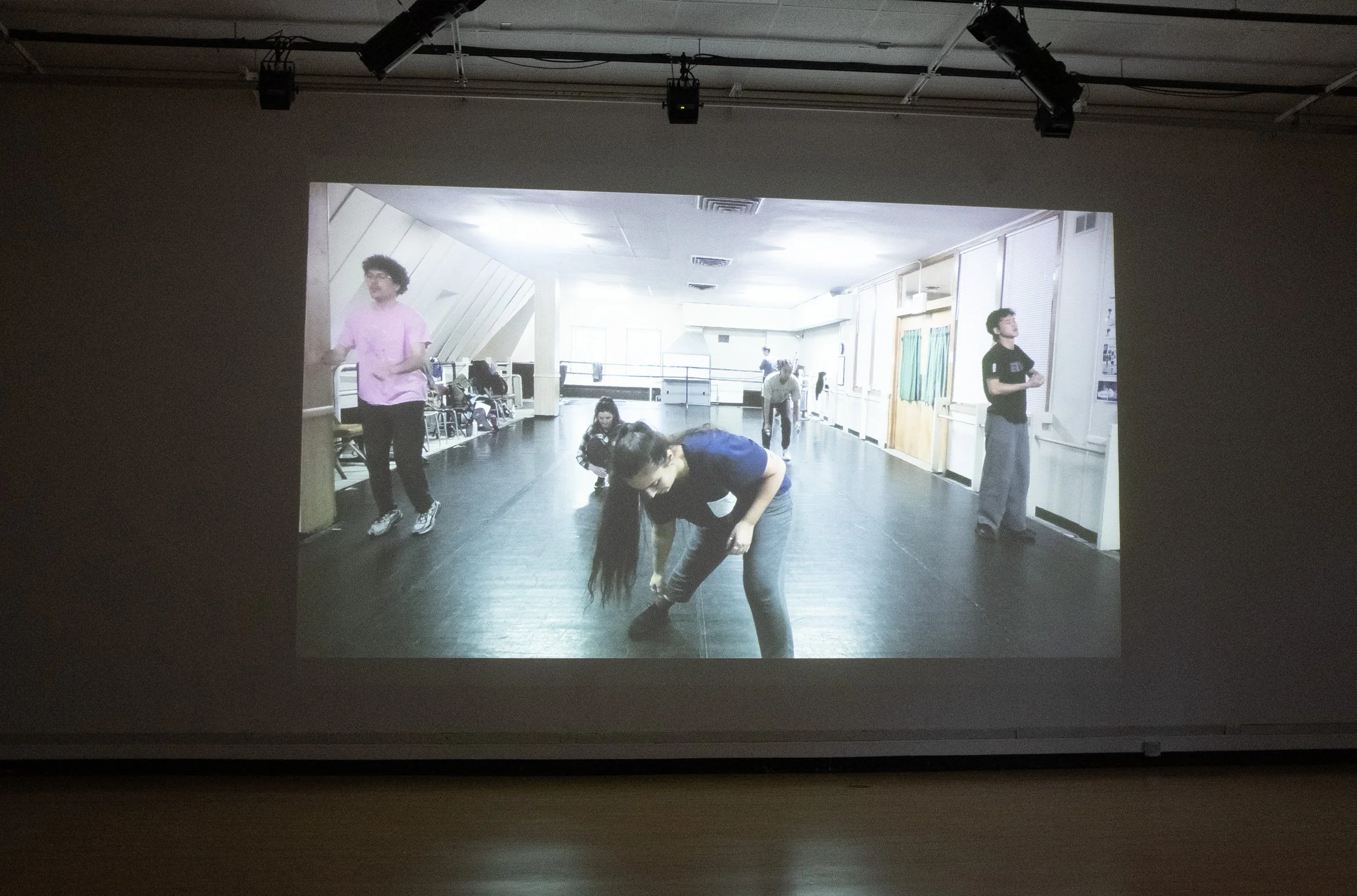
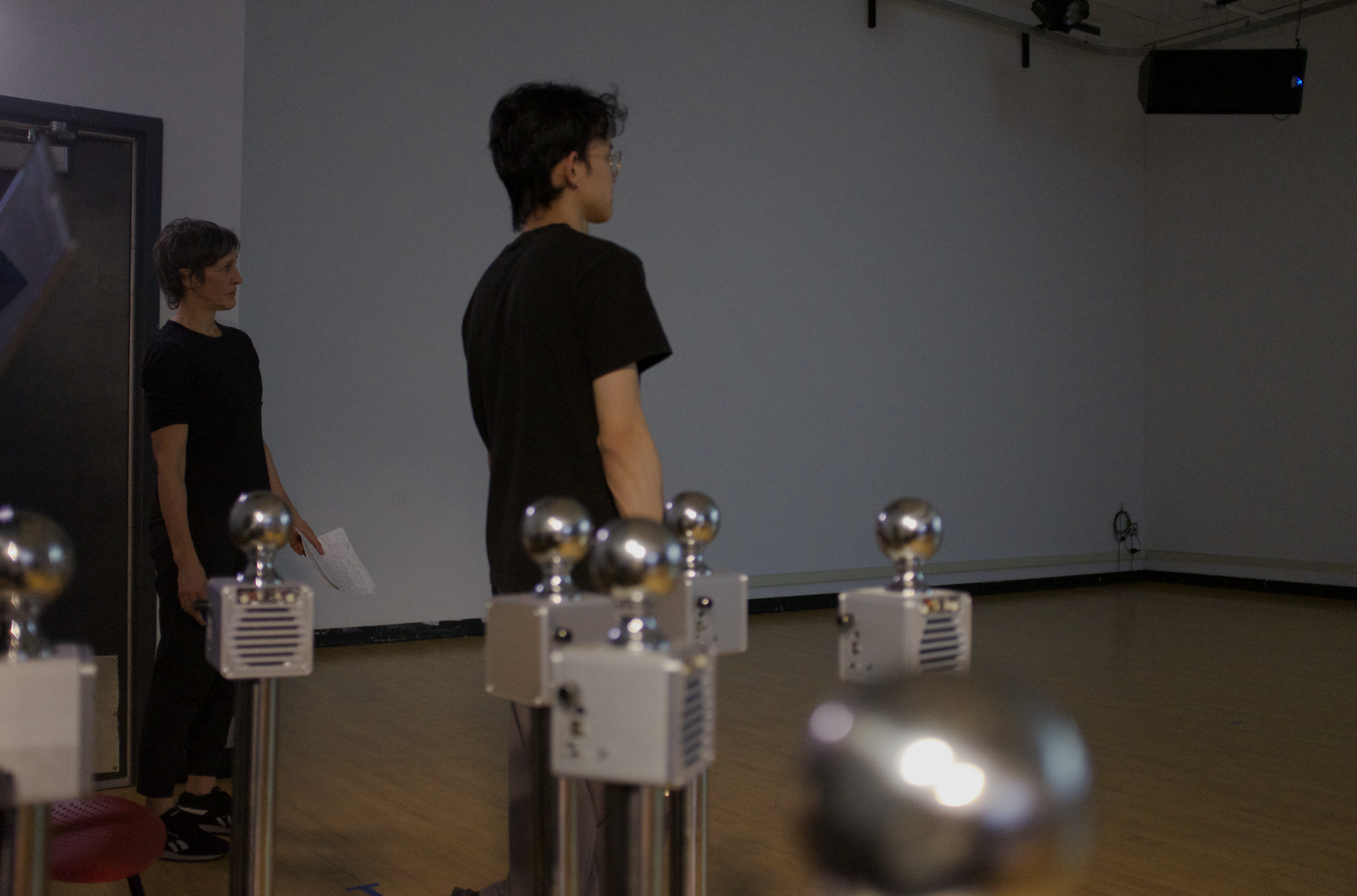
Rehearsal in December 2025.
Coaxing Through Resistance
Early in our devising process, I asked the dancers to respond to a prompt before we even got into the studio. I had them record voice memos on their phones, so they could answer privately, in their own time. The questions are going to sound a little corny, but they felt important to me. I asked them: “How do you get yourself to do something when you’re resisting it? What do you say to yourself, or set up for yourself, to make it possible?” For me, that kind of resistance is usually about fear in some form, even if it shows up in small, everyday ways. And I was interested in what people actually do in those moments. Not in a big, performative sense, but in the quiet, practical ways they motivate themselves through something and make an effort to treat themselves gently.
The responses were incredibly specific. People talked about how they speak to themselves, or how they prepare for the next day so that things feel easier, like setting out their bag ahead of time, or giving themselves a small reward, like a snack. These really small, almost invisible strategies.
I found that material completely touching. It’s not dramatic, but it’s very real. It’s all these subtle ways people coax themselves through difficulty. We tend to internalize so much harshness that small acts of gentleness and agency are, when the whole situation is taken into account, revolutionary.
We brought those voice memos into the studio and used them as a starting point for improvisation. The dancers would move while listening to each other’s recordings, or respond physically to the tone and content of what was being said. It created this interesting split, something internal and private being translated into something physical and shared.
Conclusion
Within the world of Protected By Invisible Fence, the performers seem to be training to out-maneuver a drone, as when they run in complex, geometric patterns with sudden direction changes. At other times they make themselves impenetrable by performing “upbeat” facial expressions, or they rebel against the metronomic timing of productivity by bending it with syncopation. In quieter moments, when the tracking, targeting and customization have paused, the performers enact their personal rituals of “getting themselves to do something”. How, in the wake of so much invasive prodding, does a person choose to act? The performers steel themselves, procrastinate, overshoot, try again; accelerate, decelerate, explode, settle down.
How do soft, social, multi-faceted human beings meet or resist algorithmic demands? And how might we experience interiority when we’re constantly compelled to put ourselves on display? Protected By Invisible Fence is preoccupied with the fallout from being “optimized” - how it persists in our behavior and in our minds, even after we’ve finally put our phones down.
Protected By Invisible Fence premieres at the Museum of Contemporary Art Chicago on September 18th, 19th, and 20th, 2026. You can view a promotional video for the work here.